What should the temperature be during the operation of the dehumidification and drying feeder
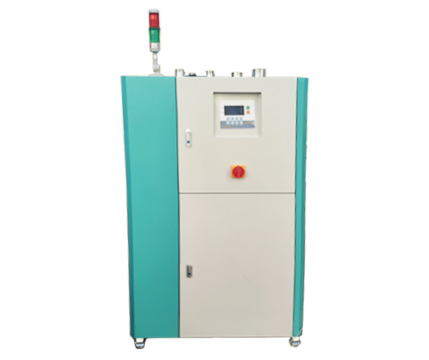
The dehumidification and drying feeder is mainly used for drying plastics with strong hygroscopicity. The dehumidification drying feeder will send low dew point air through dehumidification into one or more standard drying hoppers to improve drying efficiency and shorten drying time. The dehumidification and drying feeder uses a fan to draw moist air into the machine, exchanging heat. At this time, the moisture in the air condenses into water droplets, becoming dry air and being discharged from the machine, thereby reducing indoor humidity.
Assuming that the material supplier of the dehumidification drying feeder recommends a drying time of 4 hours and a processing capacity of 100 lb/h (1 lb=0.4536 kg). To determine whether the airflow of the dehumidification and drying feeder is sufficient, the temperature curve inside the drying silo can be measured, and special attention should be paid to the temperature at 4hr (400lb). If the temperature of the 400lb material level in the dehumidification and drying silo reaches the set value, it can be considered that the air flow is sufficient (Editor: The dehumidification and drying feeder operates without using raw materials). Only the material at 1, 2, or 3 hours in several drying silos is fully heated, which means that the air flow rate cannot heat and dry the material at the predetermined yield. Insufficient heating may indicate that the drying drum is too small, or that the productivity of the drying machine is limited due to clogged filters or damaged hoses. Excessive air volume can also cause problems, not only wasting energy, but also causing high return air temperature and damaging the performance of the desiccant.
If the material is not properly dried after being discharged from the dehumidification drying feeder, it is necessary to check if there is sufficient space in the drying warehouse to provide sufficient and effective drying time. The effective drying time of the dehumidification drying feeder refers to the time when particles are actually exposed to appropriate drying temperatures and dew points.
If the particles do not have enough time to stay in the silo of the dehumidification and drying feeder, they will not be properly dried. Therefore, attention should be paid to the size and shape of granular or crushed materials, which will affect the stacking density and residence time of dry materials. The return air filter of the dehumidification and drying feeder can prevent filamentous materials from contaminating the wheels and affecting their moisture absorption performance. To ensure sufficient airflow, the filters of these dehumidification and drying feeders must be kept clean.
;)